







Lumens or Watts? What is more important in LED lamps?
A very common question you ask us when choosing LED lamps sounds something like this: «What lamp power do I need to illuminate a 14 sq. m. kitchen? m.?»
Well, let’s figure it out:
Power and Luminous flux in LED Lamps
At a time when incandescent light bulbs were catching traction, choosing the required power of a lamp or a separate lamp was quite simple. It was rather common, and many knew perfectly well how bright it would be in a room with a 40 or 60 Watt light bulb. It was just as easy to sum up these variables. After all, the design of incandescent light bulbs was simple and understandable.
However, the current trend of using a wide range of designs and shapes of LED lamps has complicated the process of selecting them and understanding the parameters in general.
Although many people still have the habit of assessing the brightness of an LED light bulb by power in watts, now this value can only be used to judge the power consumption of the lamp, which gives a rather vague idea of its brightness.
The main parameter that can give an idea of how bright the lamp is and, therefore, how many light bulbs will be needed to illuminate the room is the Luminous Flux.
It’s not difficult to guess — the greater the luminous flux a light bulb emits, the brighter it is.
Power and Luminous flux in LED Lamps
Lumen or Lux
The sole Luminous flux or brightness of a source is Lumen.
Lumen characterizes the total amount of light emitted by a source in all directions.
In order to understand how brightly a specific surface will be illuminated, another value is used — Illumination, measured in Lux.
Unlike Lumen, Lux is a unit of illumination of a specific surface. It gives an understanding of how much light falls on 1 meter of illuminated surface.
1 LUX = 1 Lumen / 1 sq.m.
Meaning, if a lamp emitting a light flux equal to 100 Lumen illuminates 1 sq.m. surface, then a flux equal to 100 Lux will fall on such a surface. If the same light bulb is designed to illuminate a surface of 10 square meters, then the illumination of such a surface will be significantly lower.
This value depends on the design of the LED lamp, which, unlike most incandescent lamps that emit light evenly around itself, concentrates the light in the desired direction with a narrower dispersion angle.
Lumen or Lux
Lighting standards for various rooms
Different types of residential premises have their own comfortable lighting standards. Obviously, the kitchen usually requires brighter lighting than the hallway.
Let us give approximate standards for the number of Lumens per 1 sq.m. (suites) for different types of premises:
• office, library, workshop — 300
• living room — 150
• children’s room — 200
• kitchen, bedroom — 150
• bathhouse, sauna, swimming pool — 100
• wardrobe, corridor — 75
• corridor, bathroom, toilet — 50
• stairs, basement, attic — 20
• general office — 300
• conference hall, meeting room — 200
Lighting standards for various rooms
Calculation of room illumination
Using the above standards, you can determine the illumination of the entire room using the following formula:
F = E х S х k
or in other words:
Luminous flux (F) = standard illumination indicator (E) x room area (S) x ceiling height coefficient (k).
Ceiling height coefficient:
• 1 with a ceiling height of 2.5 — 2.7 m.
• 1.2 with a ceiling height of 2.7 — 3.0 m.
• 1.5 with a ceiling height of 3.0 — 3.5 m.
• 2 with a ceiling height of 3.5 — 4.5 m.
Calculation of room illumination
Focusing on the required illumination of the entire room, you can find out the luminous flux, as well as the required power of the light sources.
So how many lumens are in watts?
On average, a 1 Watt LED emits about 90−140 Lm. It depends on the quality of the LED, its manufacturing method and design.
Here is a comparative table of power (W) and illumination (Lumen\sq.m.) for different types of sources.
So how many lumens are in watts?
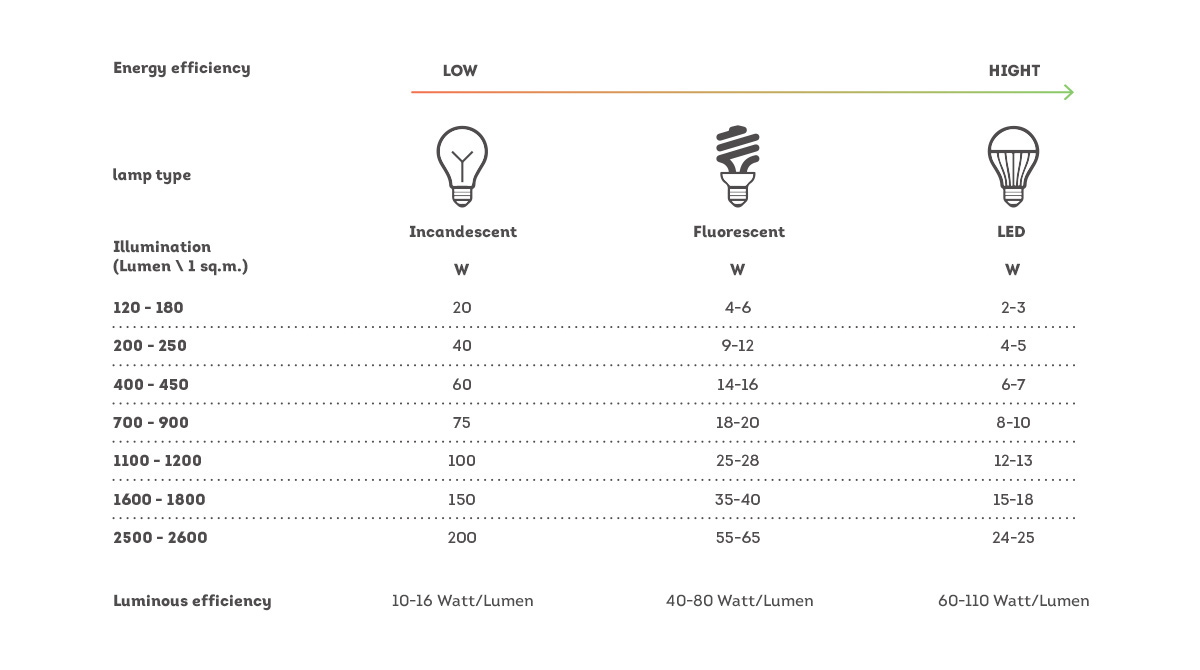
Of course, the values are approximate and depend on the design of the source (scattering angle, materials used, filters, etc.). However, now we have a relationship between power and brightness values.
Based on this table, you can see the efficiency of one or another type of lamp of varying power.
Thus, we can quite accurately answer the question that was posed at the very beginning:
«So what kind of lamp power do we need to illuminate a 14 sq.m. kitchen?»
So:
• Find the lighting standard for the kitchen = 150
• We take the ceiling height coefficient. For rooms with a height of up to 3 m, a coefficient = 1.2 is used
• Our kitchen area = 14 sq.m.
• Multiply these three indicators:
F = 150×14×1.2 = 2160 Lm.
• From the table of illumination and power it can be seen that this value falls in the power range of about 24 — 25W.
Thus, when choosing a lamp, chandelier or individual lamps, the average total power of LED sources should be in this range.
What else should you consider?
When choosing a lamp, it does not hurt to take into account the peculiarities of human vision, for which light sources with warm shades seem less bright. Therefore, when choosing lamps with a warm tint, make a small margin in the direction of increasing the power.
It is also necessary to take into account that for uniform lighting of the room it is recommended to use several lamps. And in most cases, it is advisable to divide them into several types, which will be responsible for different lighting scenarios. In any case, if there is a need to calculate a particular model, it would be a good idea to contact our consultants, who, from their experience, will tell you the best parameters for the lamps you are interested in.
Bright shopping to you!